
The best drawing ideas for beginners are simple, familiar subjects you can finish in one sitting — basic shapes, fruits, leaves, simple animals, and easy nature scenes like the moon or a cloud. Clean, recognisable outlines let you focus on line control before detail. This guide organises beginner drawing ideas by difficulty, age, time, and purpose, plus pencil-specific ideas, school and competition themes, and step-by-step drawings, so you can pick something and start.
Every idea here uses ordinary subjects and standard beginner technique — no gimmicks or invented claims. Each one is chosen for a reason (shape simplicity, proportion, or shading practice), so it's genuinely achievable, not just easy to list.
What Should I Draw? — Quick Picker
Can't decide? Match your situation to a suggestion:
| Your Situation | Recommended Drawing |
|---|---|
| First drawing ever | Apple or a single leaf |
| Want something cute | Cat face or smiling sun |
| Only 5 minutes | Moon and stars |
| Pencil practice | Leaf with visible veins |
| Drawing with a child | Butterfly |
| School assignment | My School or My Family |
| Want colour | Rainbow over hills |
| Competition | Save the Environment |
| Feeling creative | Dream house |
Difficulty-Wise Drawing Ideas
Very Easy — circles, ovals, straight lines: sun, apple, egg, heart, star
Easy — one or two shapes plus small details: cat face, butterfly, house, tree
Easy–Medium — a little proportion or perspective: bicycle, owl, teapot, coffee cup
Beginner Challenge — basic shading or observation: portrait using guide shapes, hand study
100+ Easy Drawing Ideas by Category
More than 100 easy things to draw, grouped so you can browse by interest:
Nature
Sun, Moon, Cloud, Star, Raindrop, Leaf, Tulip, Daisy, Cactus, Tree, Palm tree, Mountain, Rainbow, Snowflake, Seashell.
Animals
Cat face, Dog face, Fish, Bird on branch, Butterfly, Ladybird, Owl, Turtle, Rabbit, Penguin, Elephant, Fox face, Snail, Bee, Panda face.
Food
Apple, Banana, Watermelon slice, Ice cream cone, Cupcake, Donut, Pizza slice, Coffee cup, Teapot, Strawberry, Egg, Sandwich, Popcorn, Lollipop, Birthday cake.
Everyday Objects
Pencil, Umbrella, Shoe, Backpack, Clock, Light bulb, Key, Chair, Book, Glasses, Camera, Balloon, Gift box, Mug, Table lamp.
Cute Drawings
Smiling sun, Kawaii cat, Sleepy cloud, Chibi bear, Cute ghost, Happy cupcake, Winged heart, Baby chick, Mini rocket, Cute mushroom, Heart-eyed cat, Sleepy moon, Tiny hedgehog, Smiling flower.
Landscapes
Sunset over hills, Beach with waves, Mountain range, Night sky, Countryside fence, Forest path, Desert cactus, Snowy hut, Lake reflection, Windmill hillside, City skyline, Garden with flowers.
Simple Creative & Fantasy
Dream house, Magic wand, Small dragon, Cartoon robot, Alien face, Treasure chest, Hot air balloon, Castle silhouette, Rocket in space, Fairy wings, Unicorn head, Pirate ship, Mermaid tail.
Suggested image: a thumbnail grid, one sketch per category above. ALT text: "grid of simple beginner drawing ideas including a leaf, cat face, apple, and rainbow."
Age-Wise Drawing Ideas
Ages 4–6: sun with a face, simple house, stick-figure family
Ages 7–9: butterfly, fish, cartoon animal, garden scene
Ages 10–12: bicycle, owl, fruit still life
Ages 13–16: portrait using guide shapes, hand study, perspective street
Adults & beginners: same forgiving subjects, for confidence, not catching up
Time-Wise Drawing Ideas
5 minutes: moon and stars, single leaf, smiley sun
10 minutes: butterfly, apple with shading, coffee cup
15 minutes: cat face, flower pot, cupcake, single tree
30 minutes: sunset landscape, cottage with garden, fruit still life
Easy Pencil Drawing Ideas for Beginners
Easy things to sketch that double as skill practice:
Apple — shading
Leaf — veins & observation
Eye — proportion
Cup — ellipses
Flower — symmetry
Bird — curved lines
Easy & Beautiful Drawing Ideas
Sunset with silhouette trees — low horizon, gradient sky
Flower vase on a windowsill
Moonlit tree — dark background, light outline
Mountain scene with lake reflection
Lighthouse on a cliff
Easy Drawing Ideas for Kids
See Ages 4–6 and 7–9 above. Also try: teddy bear, ice cream cone, fish in a bowl, simple garden.
Easy Drawing Ideas for School Students
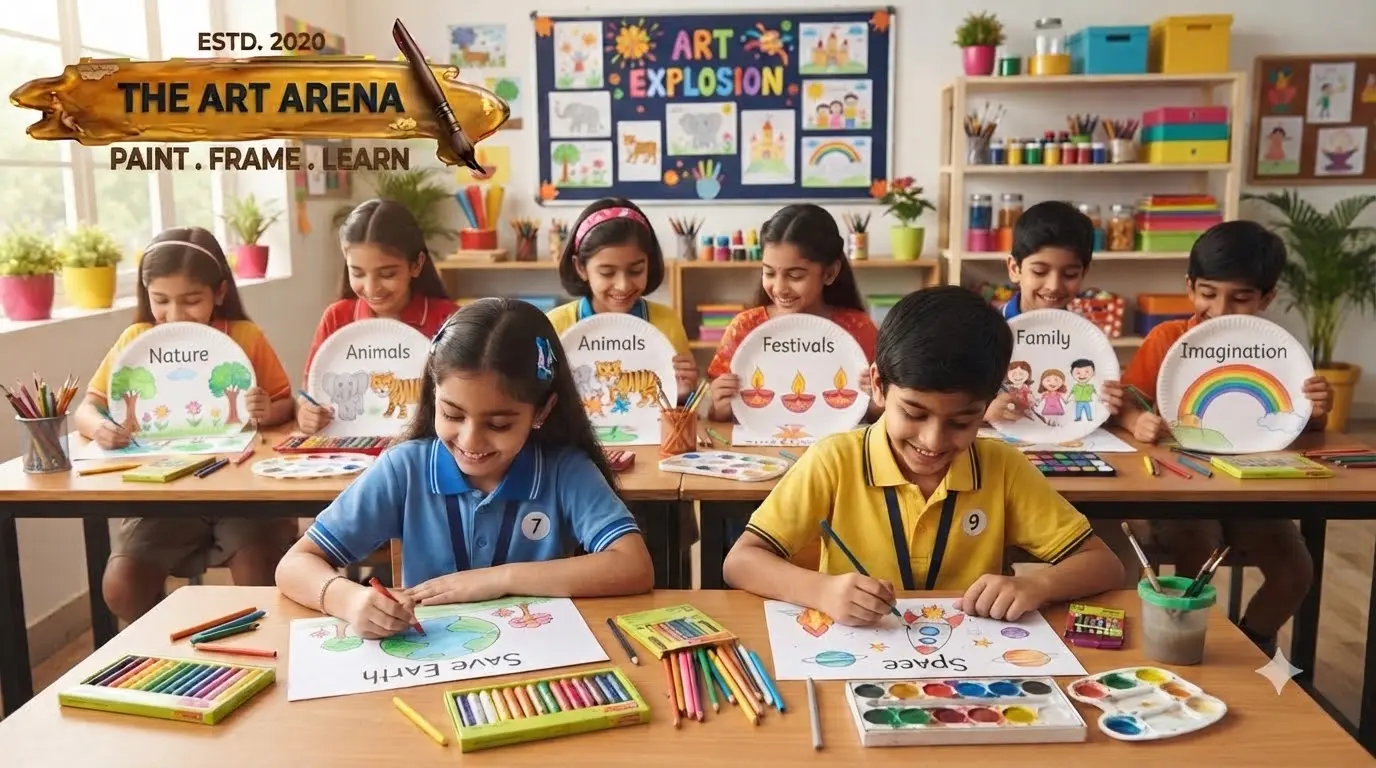
My School, My Family, Save Water, Save the Environment, festival scenes, Future City, Space, Healthy Food plate, Road Safety poster.
Easy Drawing Ideas for Competitions
A clear focal point and purposeful colour communicate better than a crowded drawing. No topic guarantees a win — composition and message matter more.
Save the Environment — hands cupped around a tree
Water Conservation — a water drop shaped like the earth
Cleanliness Drive — a broom, dustbin, and clean street
Road Safety — a zebra crossing with a traffic signal
10 Easy Drawings — Step by Step
Compact easy drawing ideas step by step — work in pencil first:
Apple: circle → stem dip → leaf → shade one side → add highlight.
Butterfly: oval body → four wings → matching pattern → antennae → shade wings.
Cat Face: circle → triangle ears → eyes & nose → whiskers → shade under chin.
Sun & Clouds: circle → even rays → bumpy cloud shapes → add a face → shade cloud undersides.
Tree: trunk → branch lines → round canopy → leaf texture lines → shade one side.
Simple House: square wall → triangle roof → door & windows → chimney & path → shade roof.
Flower: centre circle → five petals → stem & leaves → petal detail lines → shade petals.
Fish: oval body → triangle tail → top & bottom fins → eye & gills → shade the top.
Ice Cream Cone: triangle cone → waffle crisscross → round scoop → second scoop → shade undersides.
Mountain Landscape: overlapping triangles → snow caps → horizon line → sun or birds → shade one side of each peak.
Drawing Tips for Beginners
Start with basic shapes
Use light pencil strokes
Check proportions before detail
Don't erase constantly
Add shading last
Practise briefly but regularly
Use real references
Don't compare to advanced artists
7-Day Drawing Challenge
| Day | Focus | Drawing |
|---|---|---|
| 1 | Basic shapes | Sun and simple house |
| 2 | Nature | Leaf and flower |
| 3 | Animals | Cat face and butterfly |
FAQs
Questions readers often ask The Art Arena when they're just starting to draw:
What is the easiest thing to draw as a beginner?
A single object with a clean outline — an apple, leaf, or cloud.
What should a beginner draw first?
Something made of one or two basic shapes, like a sun or flower.
What are some easy things to sketch?
An apple, a leaf, or a cup — each builds a specific skill.
What can I draw in 5 minutes?
A moon with stars, or a small smiley sun.
What can a 7-year-old draw?
A butterfly, a fish, or a simple cartoon animal.
How do beginners start drawing?
Practise basic shapes first, then add detail last.
Do I need expensive materials?
No — a pencil, eraser, and plain paper are enough.
Is it okay to copy drawings from this guide?
Yes, especially early on — it teaches shape and structure.
Do I need natural talent?
Not for these subjects — they rely on practice.
Pencil, pen, or colour first?
Pencil first — mistakes are easiest to correct.
How do I choose from all these ideas?
Use The Art Arena's Quick Picker table above and match it to your time or purpose.
Conclusion
With this many drawing ideas for beginners to choose from, the hardest part is usually starting, not finding an idea. Use the Quick Picker if you're stuck, match a subject to the time you have, and treat the first attempt as practice. For more step-by-step guides and competition-ready ideas, explore more resources on The Art Arena.
Member of The Art Arena editorial team — passionate about bringing inspiring art stories and competition insights to artists across India.